Retrospective Tuning

While others have spent the month of November churning out 50,000-word first drafts, I’ve been finishing up the big new adventure sequence that opens Book Two. Yes, the bulk of that novel has been complete for some time, but when I peeled it off from Book One I created the need for additional introductory material.

Each installment of my series begins—after its punchy prologue—with an “Overture”: a largely self-contained episode which encapsulates themes explored by the novel as a whole. The Overture in A Sea Sought in Song covers Ilina’s encounter with the spiderworm, thereby introducing her relational fears and religious doubts. In Book Two, it’s Hugh Conrad’s turn to get encapsulated.

Which means he gets to go fight Soviets in the backcountry of postwar Iceland. Woot!

Though this was a fun sequence to write, it wasn’t without its difficulties. Not only was I forced to conduct historical research, and maintain the plot discipline of a functional short story, I had to do so under awkward circumstances. The two other Overtures I’d written had preceded their respective books, and I’d used them as opportunities to tune my thematic orchestra. Here, I needed to conjure the same effect after the symphony had already been performed. I needed to reverse-engineer a spontaneous manifestation of theme.

This felt disturbingly like outlining.

But it’s done now, and I’m pleased with how it turned out. And in celebration, I present to you … Hugh Conrad. I finally convinced him to sit down and have his portrait painted by the inimitable Hannah Gunderson.

On Patience

Some people are able to write with a prolificacy that leads me to question their humanity. Authors such as Brandon Sanderson and Will Wight consistently churn out multiple novels per year with a quality that’s at minimum workmanlike. I know they have support teams that scurry around like pit crews servicing Formula 1 supercars, but still. I imagine the authorial equivalent of losing eight pounds’ worth of water-weight per race must be brutal, if temporally distributed.

Perhaps I, too, would be capable of such feats if I made it big and could afford to quit my day job. But I doubt it. Even after a decade of regular writing, I still need to take breaks from time to time to refresh my imagination. And yes, it really does make a difference to the quality of my work.

So prolificacy isn’t my goal. That would be depressing. What I aspire to is constancy. A little bit at a time gets the novel written. Let the proverbial tortoise be my guide! I won’t win any races with Hare Sanderson, but in this business just crossing the finish line is all it takes to win. That, I can do.

Subcreative Startlement

The division between “outliners” and “discovery writers” seems of primeval provenance, although, for all I know, it may have been formalized and jargonized only recently. There doesn’t seem to be much overlap between these two approaches to creative writing. Most of the writers I’ve queried haven’t had trouble categorizing themselves, and I myself hail from the latter camp: I work sequentially and make stuff up as I go, constructing a lived-in storehouse of narrative material which I continually draw upon as momentum builds.

All my life I’ve been told to outline. From elementary school to high school to college to employment, the expectation has always been that I’ll iterate a finished product into being. In fact, most of my school essay assignments required me to submit multiple drafts along with the finished product in order to “show my work.”

The problem was, I don’t do “drafts.” I write from beginning to end, steadily feeling my way forward toward conclusions that encompass and encapsulate everything which precedes them. I’ve never done it any other way. I don’t know how I would. Sure, I edit the work when I’m done—but what I’m editing is a completed facade, not a scaffold.

So as a student, when asked to “show my work,” I’d just complete the assigned essay extra fast, then reverse-engineer a few dumbed-down “drafts” to make my instructor happy.

Things aren’t much different now. Even when I try my darndest to outline a scene or a chapter, the story only ever comes alive in the telling, when all the minute subliminal nuances of setting and character expression are vivified in active flux. Before I hit “play” and start typing, the story’s just a static image. I can guess what it’ll do and where it’ll go, but my guesses usually suck. It’s in the moment, when a character opens his mouth, that I suddenly know the right thing for him to say.

Case in point: I spent last week attempting to outline my latest scene. I was straining to envision the specificities of various interpersonal conflicts and how they’d affect the plot. I thought I had a pretty okay structure. So I dove in and started writing, and immediately a character started saying something unexpected. I wasn’t quite sure what it implied, but it felt right, so I went with it. And then a lightbulb ignited and I realized what a gift this character had given me—how I could leverage his revelation to ratchet up tension in the plot, and explain various incongruities, and foreshadow future developments.

I never could’ve outlined that. I’m simply not smart enough. I lack the requisite foresight.

But one of the benefit of my shortsightedness is that I’m often just as startled by events as my characters are, which helps me to write them empathetically. Also, it’s kinda thrilling to know I can always be surprised, even in my own subcreation.

The Truth Will Weigh You Down

As part of my Great Reorganization of Seed of Glory Sown in Sorrow, I’m amplifying several previously-downplayed subplots in what is now Book Two, as well as introducing brand-new locales and characters. One aspect of the latter project involves going back in time and out-of-world—to visit Hugh Conrad before he’d ever heard of Arlam.

This is a thrilling prospect, because Hugh has an eventful backstory. And not only does this allow me to open Book Two with a James-Bond-style “featurette intro” as I do with the series’ other installments, it also sets the stage for Hugh’s latter, more controversial decisions—planting the reader more deeply into his mindset from the outset, building sympathy for a character who simply doesn’t care about your opinion.

However, this new, chapter-length scene takes place on Earth. And not a small-scale fictional location, either: in a very specific—and foreign—historical time and place. Previously, my narrative forays to Earth hadn’t ventured beyond tightly-controlled environments: mainly an isolated rural estate in upstate New York.

This is different. This time, I may actually offend knowledgable readers if I get details wrong. So my first day writing the scene in question was spent poring through online archives that covered everything from historical social relations to the provenance of specific backroads to the inner workings of very dated technology.

Ugh.

I have huge respect for writers of historical fiction (and nonfiction!), but this experience reinforces my lack of desire to become one. Writing fake worlds certainly has its perks.

Verse Sans Context

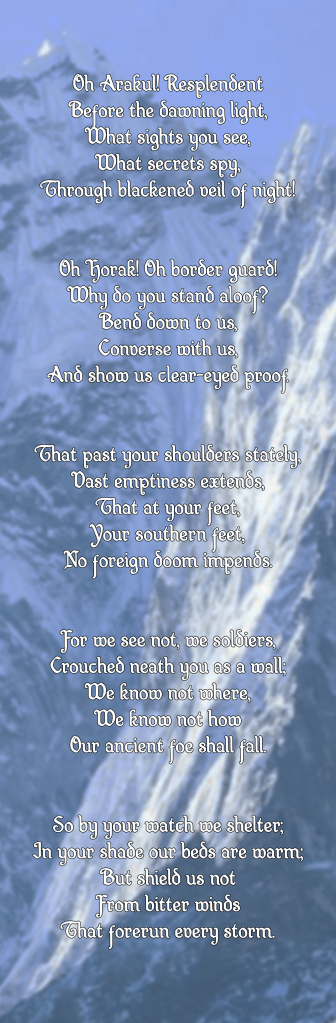
One of the results of my series’ subdivision has been the need for more poetry. It’s no secret that I love epigraphs. I love the sense of mystery, significance, and anticipation they can create at the outset of a hefty fantasy tome, and I want to provide that kind of experience for my readers.

This is the poem which now opens Book Two. I knocked it out last week while waiting for an animation to render at work. I don’t mind sharing it, as it wasn’t so long ago that Book Two was just the second half of Book One. I’m pretty happy with the tone it sets for what is now the dire Second Act of the Seed of Glory Sown in Sorrow saga.

OhArakul01_v02